Agents search.
TrustPixel lets them buy.
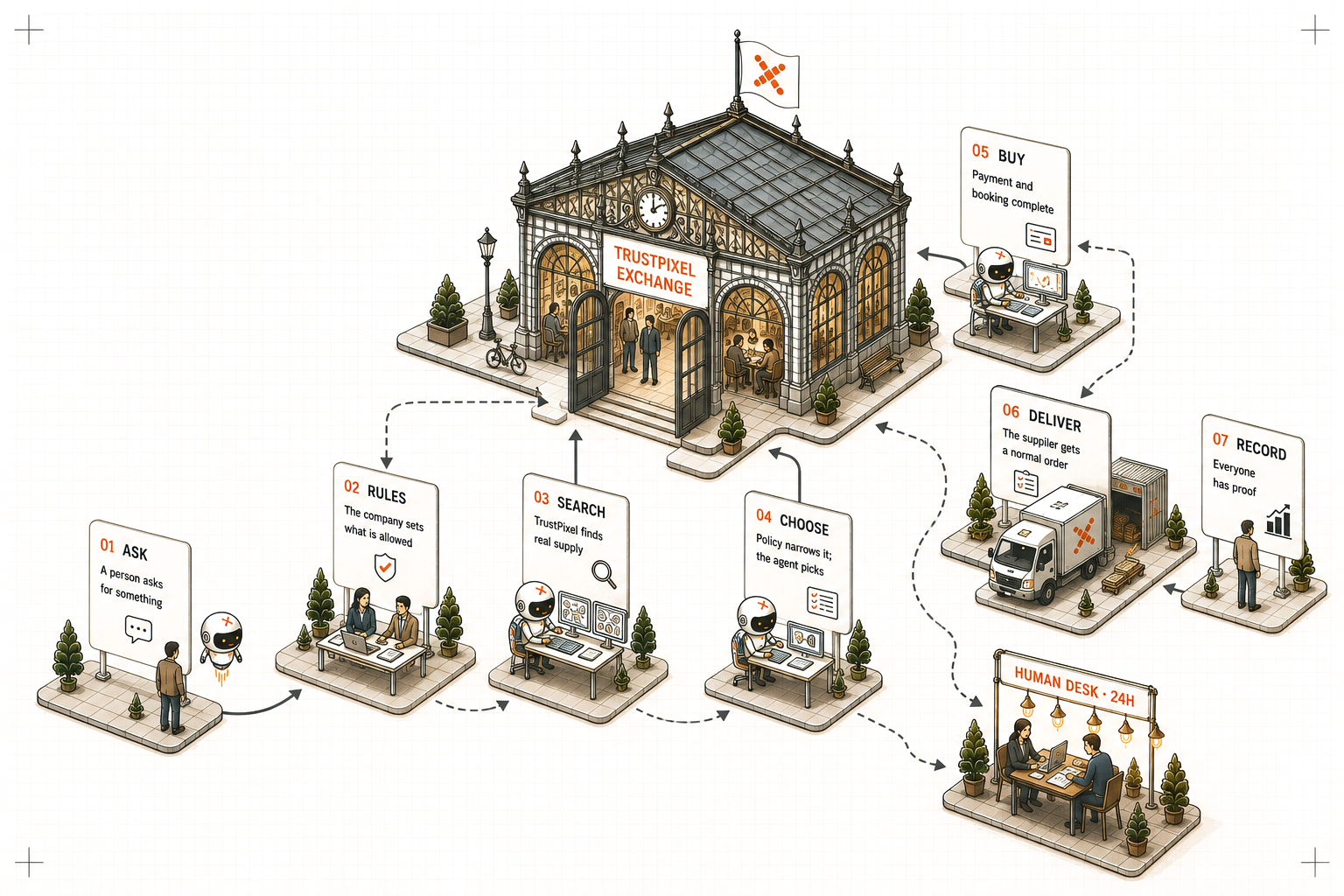
One purchase, end to end
- 01 Ask A person asks for something
- 02 Rules The company sets what is allowed
- 03 Search TrustPixel finds real supply
- 04 Choose Policy narrows it; the agent picks
- 05 Buy Payment and booking complete
- 06 Deliver The supplier gets a normal order
- 07 Record Everyone has proof
TrustPixel turns an authorized request into a completed transaction across live supply, under the buyer's rules and the supplier's terms.
A thousand searches.
One booking.
The traffic already arrives. It never books.
Your agent finds it. Then stops.
Connect once. Every compatible AI agent can buy from every connected supplier.
TrustPixel is the step that is missing.
This gap is being filled right now, either by scraping and shared credentials or by infrastructure. We are building the second one.
One API instead of one integration per supplier, and purchases that complete rather than hand the user a link.
What builders get →You set the prices, the terms, and exactly what agents may buy. You keep the customer.
What suppliers get →Spending limits, approvals, and payment controls stay yours, enforced before anything is bought.
What businesses get →Why AI transactions are different from a pile of APIs.
The full answer →Every supplier becomes another engineering project. Nothing compares cleanly, nothing recovers the same way, and there is no single record of what happened.
Every purchase is worked out before it happens.
Five things sit between a request and a completed purchase. Each is a place an agent on its own gets stuck.
{{ optWhat }}
Stop building supplier integrations.
Finishing the purchase is a different job from working out what someone wants, and the same job for every supplier you add.
Start buildingEvery AI agent becomes a new sales channel.
You publish what agents may buy, at your prices, executed on the systems you already run.
Become a supply partnerAI purchasing your finance team will actually approve.
The objection is never capability. It is control: limits and approvals are enforced before a purchase happens, not asked of the model.
Talk to usAgents do not need another storefront. Suppliers do not need another closed marketplace.
The internet had to agree on how to move information. Payments had to agree on how to move money. Agent commerce has to agree on how to complete a transaction.
It does not own the catalogue, the prices, or the relationship.
Shared infrastructure, not another destination.
How it is built →The exchange takes the shape of the market.
You never need to read this. It is here because infrastructure buyers ask what a transaction actually looks like.
Watch a purchase, step by step * IllustrativeThree ways in. One exchange.
Get a sandbox key, run a full purchase against simulated supply, then ask for production access.
Tell us what you sell and which systems you run. We will show you what agent demand looks like in your category.
Bring governed demand. Define policy, budgets and approvals once, and have them enforced wherever your people buy.